From Thailand, to Coworking, to HTML5, Now to Next Generation eBooks: Refocusing My Blog
I started this blog in 2001 as a travel blog as I lived in South East Asia, ending up in a Thai Muslim village two weeks after September 11th after having moved out of New York City just a few months before (after having worked downtown in the Financial District, no less!). Here's a short excerpt from October 16th, 2001 that gives a sense of what life and this blog was like for me then:
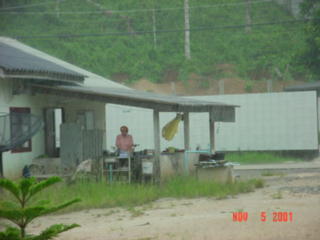
My neighbors house in Thailand
While my house was higher than the rising waters, a river was rushing down the street and flooding into my Muslim neighbor's house. I decided to head out into the water to help him, and grabbed a large plastic trash can to bail out water. I headed over there and told them I wanted to help. I followed Koon Son, the man of the house, over to a construction site. We grabbed all the wood and cement we could to build a barrier around the front of the house, to divert the rushing water.
After moving back to the States, codinginparadise.org segued into a forum to talkabout the work I was doing on Paper Airplane, an open source P2P browser focused on deep collaboration and editing on the web:
A full WYSIWYG editor built into the browser
What if community and editing were a central and transparent part of the web and browsers? What if the web was extremely integrated for usability, with instant messaging, site creation, the web server, and more all integrated into one whole? What would this web look like if despite being integrated it was massively decentralized on a peer-to-peer network, able to exist and run without businesses or governments?
After Paper Airplane, codinginparadise.org morphed into a forum to talk about coworking as I was inventing that:
The very first coworking group was at the very funky Spiral Muse space
Traditionally, society forces us to choose between working at home for ourselves or working at an office for a company. If we work at a traditional 9 to 5 company job, we get community and structure, but lose freedom and the ability to control our own lives. If we work for ourselves at home, we gain independence but suffer loneliness and bad habits from not being surrounded by a work community.
Codinginparadise.org also acted as a place for me to share my experiments with trying to hijack and honeybadgernewcapabilitiesinto the browser—this was the Great Dark Ages of the web when browsers were terrible and IE had won. During this time I did mad experiments in such things as getting Ajax History working, getting offline web apps going, and more, trying to reboot a new kind of world for JavaScript and web developers. Much of this work actually ended up feeding into HTML5.
Trying to evangelize HTML5 in 2009 before it was mainstream
Which brings us to today. As some of you might know I've been at Inkling for three years focused on trying to imagine what a next generation eBook should look like and how we can produce them at scale using Inkling Habitat, a beautiful, shared, and open collaborative publishing environment designed for professionals. I've been relatively quiet on this blog the last few years.
Chapter Overview in Inkling Habitat
I'm incredibly passionate about what Inkling and others are doing in the eBook and publishing space.
We are at a profound inflection point with books and eBooks, another point on a path that stretches back thousands of years: from clay tablets, to scrolls, to codices, to cheap dime store novels, to ebooks, to next generation ebooks. These new long form containers are no longer on paper, so they can accordion from short to long based on the person encountering them. They can be randomly indexed, act as databases, inform using more than words, and more. They can intelligently assess the person experiencing them, shifting based on interest, background, and knowledge.
The book isn't dead at all, just our expectations of what the book can be.
An entirely new kind of eBook is possible, one that is somewhere between an eBook and an App. One that has a textual narrative as its core but has interactivity where appropriate with high definition video, audio, JavaScript, and more. These next generation eBooks should live on the web, be built with HTML5 and open standards, and be indexable by search engines.
The book isn't dead at all, just our expectations of what the book can be. The next few years are going to be incredibly exciting.
This is our generation's answer to what a book can be.
Cuneiform tablet showing how beer is made
I'm kicking off a new blog series focused on these new kinds of eBooks and the tools used to produce them. I call them Next Generation eBooks to differentiate them from the relatively simple, ten dollar text file eBooks that are already out there.
Amazon and the Kindle have figured out pretty well how to take traditional books and bring them onto digital reading devices. Things like Whispernet and eInk have been a fairly good vehicle for bringing traditional books over to the computer. Reading Virginia Wolf's To the Lighthouse on a digital screen doesn't really need to be much different—just let the words be front and center and get out of the way, which the Kindle does very well.
However, what about the world known as illustrated non-fiction, everything from textbooks to cook books to travel books? Frankly none of these should have been physical books to begin with; in the past the only option was to print them on dead mulched wood. An entirely new kind of eBook should be crafted for these genres, a Next Generation eBook.
In fact, even literary fiction could benefit from being next generation eBooks; for example, I'd love to read an annotated version of Marco Polo's travels that has beautiful maps integrated, sidebars providing further information on each of the locations he visits, HD video interviews with leading scholars and archaeologists on Polo's travels, deep metadata and modularity for the content so it gets indexed well by search engines, and more.
Marco Polo's Travels—I guess you could call this a Next Generation Illuminated Manuscript
Significant challenges remain to make this vision a reality. This is really in some ways an entirely new market segment. It's still confusing about how do people find these new kinds of next generation eBooks: do they find them in an app store, do they find them on the web, or do they find them through an online bookstore? In addition we have to raise consumer expectations that eBooks can be better, they can have higher quality, have greater beauty, and be interactive.
There is also the challenge of having publishers care about their digital editions and create digital works they are proud of that rise beyond being commodity text files. The challenges are large and exciting: everything from raising consumer expectations, to creating a pipeline of material to feed demand, to creating new publishing tools to feed these new kinds of eBooks, to creating reading platforms that tie into this whole new world.
On a personal note this is why I'm so excited about Inkling. Inkling is tackling these problems, trying to solve this multi-dimensional equation to make this world a reality. As an act of shameless promotion I will note that Inkling is hiring if you want to tackle incredibly ambitious problems like this whether through technology, business, sales, UX, or product design.
All of this is a long winded way of saying expect much more material on codinginparadise.org on next generation eBooks. A very important note that I am not speaking for Inkling here. These are my own ramblings and my own thoughts.
I'll be reviewing interesting next generation eBooks both from Inkling and others, such as Touch Press. In addition, I'll be reviewing unique writing tools that are being produced to create these new kinds of eBooks, including new features in Inkling Habitat. We need a whole new generation of writing and publishing tools to make this promise true. I like to say you can't revolutionize the book without also revolutionizing the printing press.
Note that this means I will sometimes be reviewing products from competitors. We are all working towards the same goal, even if we are taking different ways of getting there, and I think its important to show all the interesting, flourishing activity happening out there no matter where it comes from. I'll do my best to be fair and evenhanded when reviewing things that might be from competitors, and will always be clear that I work at Inkling on Inkling Habitat (and again, remember that everything I write here is my own opinion and in no way is condoned by my employer).
On a personal note this is why I'm so excited about Inkling. Inkling is tackling these problems, trying to solve this multi-dimensional equation to make this world a reality.
Something I'll also be doing is observing the past and other efforts that have tried to do this. It's not a new thing to try to re-invent the book in a new direction, all the way back to things like HyperCard in the 80s; the innovative Voyager Company in the 90s with interactive multimedia CD-ROMS; and all the way into the 2000s with things like Shockwave and even Flash, which both tried to re-imagine how educational materials should be made. I'm a big supporter of knowing your history—this effort is not a new one, and its constructive to study the past so we can see what worked and didn't work.
There are many interesting individuals in this space that I would love to interview, so expect interviews as well!